Reviewing the Wee Woo Truck Paramedic Design
As a designer who spends half my life staring at digitized files and the other half watching needles punch through fabric, I have learned that not every cute graphic translates well to thread. When I first opened the Wee Woo Truck Paramedic T-Shirt file, my initial reaction was one of cautious optimism. The concept is undeniably charming: a playful nod to the brave souls in emergency services, tailored specifically for their littlest supporters. But charm alone does not make a viable machine embroidery design. We need to look at line weight, color separation, and stitch path efficiency.
This review comes from a place of practical application. I am not just looking at a pretty picture on a screen; I am evaluating how this embroidery file will behave when hooped up on a Tuesday morning rush order for a local craft fair. Whether you are an Etsy seller looking to expand your niche or a hobbyist making a personalized gift, understanding the technical reality of this design is crucial before you commit to stitching.
First Impressions and Visual Personality
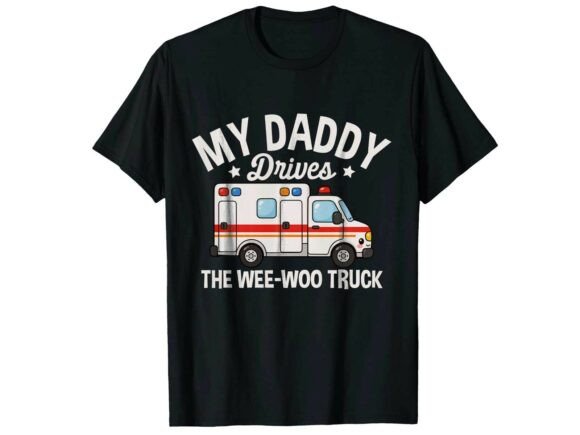
The mood of the Wee Woo Truck Paramedic T-Shirt design is lighthearted and affectionate. It avoids the overly serious or clinical aesthetic often associated with medical themes, opting instead for a soft, approachable vibe. The typography is playful, which is essential when targeting parents and children. From a design perspective, the balance between the ambulance graphic and the text feels intentional. It does not crowd the hoop, nor does it feel sparse.
For those of us creating T-Shirt Designs and Graphics for print, we often rely on gradients and fine lines. In embroidery, these elements can be disastrous. This design appears to respect the limitations of the medium. The shapes are bold enough to hold their form under tension, and the lettering seems sized appropriately to remain legible without becoming a tangled mess of thread. It feels like a design built for durability, not just display.
Real-World Application: The Sweatshirt Test
To truly test the viability of this design, I imagined a specific real-life scenario. A customer approaches my small shop requesting a custom item for her three-year-old son, whose father is a paramedic. She wants something cozy, durable, and proud. I chose a mid-weight cotton fleece sweatshirt as the base garment. This is a common request for sweatshirt embroidery, and it presents specific challenges regarding fabric stretch and pile.
Stitching the Wee Woo Truck Paramedic T-Shirt onto fleece requires careful attention to stabilizer choice. Because the design includes both solid areas (likely requiring fill stitch) and outlines (likely satin stitch or running stitch), the tension must be balanced. If the stabilizer is too light, the fleece will pucker around the ambulance wheels. If it is too heavy, the garment becomes stiff and uncomfortable for a child. In my mental simulation, using a cut-away stabilizer provided the necessary support without sacrificing comfort. The result was a crisp, professional-looking finished product that held up well to the texture of the fabric.
Versatility Across Product Lines
Beyond sweatshirts, this design shows promise across various custom apparel and home goods. Here is how it performs in different contexts:
- Tote Bags: As a tote bag design, the bold lines stand out against canvas. It makes for a sturdy, everyday item that a child can carry to preschool.
- Caps and Hats: Curved surfaces are tricky. The design’s width needs to be checked against standard cap hoop sizes. If the text is too long, it may distort on the curve. However, if scaled correctly, it makes for a standout embroidered patch style look.
- Baby Items: For baby embroidery, softness is key. Using lighter thread weights and ensuring no scratchy backing touches the skin is vital. This design’s cute aesthetic fits perfectly here, provided the stitch density is not too high.
- Holiday Gifts: During the holiday season, holiday embroidery trends lean toward family-centric themes. This design fits naturally into gift sets for first responders, adding emotional value to the physical item.
Technical Considerations and Potential Pitfalls
While the design is strong, there are areas where caution is required. Any experienced embroidery designer knows that tiny details are the first to fail. If the Wee Woo Truck Paramedic T-Shirt includes very small text or intricate details on the ambulance (like tiny lights or medical symbols), these may not stitch out cleanly on textured fabrics like terry cloth or waffle knit.
Fabric texture plays a massive role. On a smooth poly-cotton blend, the design will look sharp. On a rough linen or a loose-knit sweater, the edges may fray or sink into the fabric. I recommend always testing the design on scrap fabric that matches your final product. This is non-negotiable for maintaining professionalism in a craft business.
Additionally, consider thread colors. The design likely relies on specific contrasts—perhaps reds, whites, and blues. If you are stitching on a dark navy shirt, you must ensure the white threads have enough coverage. Sometimes, a underlay stitch is necessary to prevent the background fabric from showing through the lighter colors. Always check the color sequence in your software before hitting start.
Scaling and Hoop Size Constraints
One common mistake makers make is resizing embroidery files arbitrarily. Unlike vector graphics, embroidery files have fixed stitch counts. Shrinking the Wee Woo Truck Paramedic T-Shirt too much will cause stitches to overlap and bunch, creating a dense, hard lump. Enlarging it too much will reveal gaps between stitches, ruining the visual appeal. Always check the recommended hoop size provided with the digital embroidery file. If you need a larger or smaller version, it is often better to find a different size variant of the file rather than forcing a resize.
Enhancing Brand Value and Customer Trust
Using high-quality, well-digitized designs like this one directly impacts your brand perception. When a customer receives a handmade product that looks clean, symmetrical, and durable, they trust your expertise. Sloppy stitching, on the other hand, can damage your reputation quickly. The Wee Woo Truck Paramedic T-Shirt offers a polished look that elevates the perceived value of the item. It allows you to charge a premium because the finish is professional.
For small shop product listings, clear photography is essential. Use printable mockup tools to visualize the design on different garments before you stitch. This helps in planning your inventory and marketing materials. Showing the design on a variety of items—aprons, pillows, shirts—demonstrates versatility to potential buyers.
Final Designer Notes
Before you purchase or use this design, there are a few final checks to perform. First, confirm the licensing terms. Can you use this for commercial embroidery? Most designers allow finished products to be sold, but reselling the design assets themselves is usually prohibited. Read the license carefully.
Second, inspect the file format compatibility. Ensure your machine reads the specific file type provided (such as PES, DST, or JEF). If you are unsure, consult your machine’s manual or software documentation.
Finally, remember that embroidery is a partnership between the digital file and the physical materials. The Wee Woo Truck Paramedic T-Shirt is a strong candidate for your next project, offering a blend of emotional resonance and technical feasibility. By respecting the material constraints and paying attention to detail, you can create items that bring joy to paramedic families and pride to your portfolio. Treat each stitch with intention, and the results will speak for themselves.